Sunday, February 20, 2011

The Singapore Way

Source:McKinsey report: How the world's best performing school systems come out on top

Related:
If Singapore has one thing to teach America, it is about taking governing seriously, relentlessly asking: What world are we living in and how do we adapt to thrive. “We’re like someone living in a hut without any insulation,” explained Tan Kong Yam, an economist. “We feel every change in the wind or the temperature and have to adapt. You Americans are still living in a brick house with central heating and don’t have to be so responsive.” And we have not been

Saturday, February 19, 2011

Improving Government Performance- You do whatever it takes

When it comes to failing schools, Sir Michael expresses impatience. When a public school is failing — not just going through a rough patch, but also systematically failing to educate its students — he says there is only one question the authorities should consider: “How do I get these children a good education as fast as possible?”

“Once you have the answer to that question, you just do it,” he said. “If it’s close the school, you close it and move the children into a better one. If there are no better schools nearby, close it and replace it with another on the same site. But you do whatever it takes.”
-Imported From Britain: Ideas to Improve Schools

Related;
Education Reform Lessons from England

'Deliverology' is the way forward, says Barber

US Education Delivery Unit


Tony Blair on Deliverology

Blair talks about the Delivery Unit as one of his successes in his memoir and gives credit to Sir Machael Barber.

'It was relatively a small organizatiion, staffed by civil servants but also outsiders from McKinsey, Bain and other private sector companies, whose job was to track the delivery of key government priorities. It would focus like a laser on an issue, draw up a plan to resolve it working with the department concerned, and then performance-manage it to a solution. It would get first-class data which it would use for stocktakes that I took personally with the minister, his key staff and mine, every month or so. The unit would present a progress report and any necessary action would be authorised....

We also created the Strategy Unit, to look ahead at the way policy would devlop, the fresh challenges and new ideas to meet them. That also was higly successful. It allowed us to take a medium- and even long-term view of certain issues that were looming but not imminent. Whereas the Policy Unit handled the day-to-day and focused on managing the departments to produce the policies and their implementation that derived from the manifesto or the departmental plans, the Strategy Unit was trying to trying to construct the next policy platform...

In summary, extra money plus system change delivered results...'

Related:
Imported From Britain: Ideas to Improve Schools

“What have all the great school systems of the world got in common?” he said, ticking off four systems that he said deserved to be called great, in Finland, Singapore, South Korea and Alberta, Canada. “Four systems, three continents — what do they have in common?

“They all select their teachers from the top third of their college graduates, whereas the U.S. selects its teachers from the bottom third of graduates. This is one of the big challenges for the U.S. education system: What are you going to do over the next 15 to 20 years to recruit ever better people into teaching?”

Thursday, February 10, 2011

Social Impact Bonds or PPP Reinvented?

David Cameron’s Conservative government in Britain is already testing it, at a prison 75 miles north of London. The Bloomberg administration in New York is also considering the idea, as is the State of Massachusetts. Perhaps most notably, President Obama next week will propose setting aside $100 million for seven such pilot programs, according to an administration official.

The idea goes by one of two names: pay for success bonds or social impact bonds. Either way, nonprofit groups like foundations pay the initial money for a new program and also oversee it, with government approval. The government will reimburse them several years later, possibly with a bonus — but only if agreed-upon benchmarks show that the program is working.
-For Federal Programs, a Taste of Market Discipline
Related;

A Bond to Save Lives

What Are Social-Impact Bonds?

Wednesday, February 9, 2011

PFM Lesson of the Day

Albert van Zyl reviews some reviews of PFM systems;
So for example, Matt Andrews (2010), in his study of 31 countries in Sub-Saharan Africa found that “they have alarmingly similar reforms in place” (page 44), “an MTEF was implemented in 28 countries, programme budgeting in 25 and an IFMIS in 20”. As a result of these findings, Andrews calls for “less similarity of reforms and more context appropriateness”, as one of his three main recommendations.

Related:
Weekend reading- Mathew Andrews paper mentioned above.
Budgets are made better than they are executed

Obama's Management Agenda checklist

A quick list of Obama's planned management reforms;
  1. The promise to create a “chief performance officer” reporting to him
  2. The promise to replace the Program Assessment Review Tool (PART) with a new Performance Improvement and Analysis Framework
  3. The appointment of Jeff Zients as the chief performance officer, and as deputy director for management at the Office of Management and Budget
  4. A commitment to a governmentwide performance portal
  5. The creation of “high-priority performance goals”
  6. A commitment to program evaluation
  7. The outlining of six “performance strategies” for the Administration’s Accountable Government Initiative.


Better Know Your Baselines

Why baselines are important;

Baselines are essentially the status quo, the starting point for whatever fiscal discussion you're having, and help show the change certain policies might have on the federal budget. However, as TaxVox, the Tax Policy Center's blog, pointed out in a great post last year, not everyone uses the same baseline, and some baselines are better than others

Monday, February 7, 2011

Does India need a PAIS?

Better and more effective Planning of government expenditures has many elements. Some of the elements of planning that need improvement have been discussed in this note. These include clearer definition of program outputs and outcomes and detailed operational plans for achieving these goals. With the availability of new technology, government management information systems and public accountability can be vastly improved. The paper proposes a Public accountability information system (PAIS), with a web enabled public information system and a smart card recording all the benefits that the poor are entitled to receive through government programs. This would empower the poor, particularly in rural and remote areas, by converting entitlements into a financial right – a virtual credit/debit card based on government funds. If implemented sincerely, with inevitable modifications and adaptations arising out of implementation experience, this can help improve the efficiency and effectiveness of government expenditure over the next five years.
-PLANNING FOR RESULTS: The Public Accountability Information System
Working Paper No. 1/2007-PC, India National Planning Council Working Paper

Expenditure Tracking in India

The connection between release of funds by the Central Government and actual expenditures for physical inputs by the implementing agencies is
currently, very obscure

We highly recommend the Report of the Technology Advisory Group for Unique Projects, the chapter on Expenditure Information Network.

Friday, February 4, 2011

Recent Reports - Indian Government

Report of the Technology Advisory Group for Unique Projects

Public Debt Management


Report of the Working Group on Foreign Investment in India

Outcome Budget

India's Independent Evaluation Office

The Union Cabinet today approved the establishment of an Independent Evaluation Office (IEO) to undertake impartial and objective assessment of the various public programmes and improve the effectiveness of public interventions. This is in pursuance of the Presidential address to the Joint Session of both Houses of Parliament in June, 2009 to establish an Independent Evaluation Office at an arms' distance from the Government to assess the outcomes and impact of the major flagship programmes of the Government of India.

The IEO will be an independent office attached to the Planning Commission under a Governing Board chaired by the Deputy Chairman, Planning Commission. It will be funded by the Planning Commission and will have, as its head, a full-time Director General (DG) in the rank and status of Member, Planning Commission. It will have full functional autonomy to discharge its functions. The IEO will also advise the Planning Commission and the implementing agencies in developing appropriate management systems consistent with the evaluation objectives.

Saturday, January 8, 2011

Job Opportunities

RA job at BIS- deadline 24th January. Qualification required- Master's in economics, econometrics or statistics.

Jobs at Institute of International Finance

Development NGOs of the Week- DAI

DAI’s mission is to make a lasting difference in the world by helping developing nations become more prosperous, fairer and more just, cleaner, safer, healthier, more stable, more efficient, and better governed.

DAI Washington traces its origins to 1970, when three graduates of the John F. Kennedy School of Government at Harvard University combined their savings, aspirations, and career goals to establish a consulting firm in Washington, D.C., focusing on market-based approaches to economic development. DAI Washington's founders were bold and persistent. They named the company “Development Alternatives, Inc.”—now known simply as DAI—to emphasize their commitment to innovation and new ways of solving problems.

See more job opportunites at DAI

Cascading Peformance Agreements

For Discussion: Which type of performance arrangements is best suited for a small island developing countries?


Source: Performance-based Arrangements for Senior Civil Servants: OECD and Other Country Experiences

Saturday, December 18, 2010

Government Results Act fails

The bill, known as the 2010 Government Performance and Results Modernization Act, would also have required agencies to post program performance scorecards on a single public website on a quarterly basis, the release said.

It set a first-year goal of a 10 percent reduction in the number of written reports required by previous Congresses and presidential administrations that are little used or obsolete. As Federal Times has previously reported, agency officials sometimes have to compile massive reports that are outdated as soon as they are printed.

"Taxpayers fund 44 separate programs in nine different federal departments that support workforce training, and we also pay for 17 separate initiatives across seven federal departments that deal with food safety," Warner said in the release. "We need a better system — a system that allows us to review the results of each program and evaluate its impact in addressing overall policy goals, whether it's the important work of retraining people who've lost their jobs or ensuring the safety of the food we eat."

The Obama administration has already created its own website, performance.gov, to track agency progress in meeting high-priority goals laid out in the administration's 2011 budget request. The site, available to federal managers since August, was supposed to open to the public this year. That move has now been delayed to "kick the tires a little more" and to get agency feedback, Office of Management and Budget spokeswoman Moira Mack said Friday
-House kills bill to improve agency performance

We Promise to Obey IMF and adopt a Fiscal Responsibility Law

Ireland's Letter of Intent;

We are preparing institutional reform of the budget system taking into account anticipated reforms of economic governance at the EU level. A reformed Budget Formation Process will be put in place. Furthermore, we will introduce a Fiscal Responsibility Law which will include provision for a medium-term expenditure framework with binding multiannual
ceilings on expenditure in each area by end-July 2011 (structural benchmark). A Budget Advisory Council, to provide an independent assessment of the Government’s budgetary position and forecasts will also be introduced by end-June 2011 (structural benchmark). These important reforms will enhance fiscal credibility and anchor long-term debt sustainability.

Friday, December 10, 2010

CATO Balances the Budget

Downsizing the Government

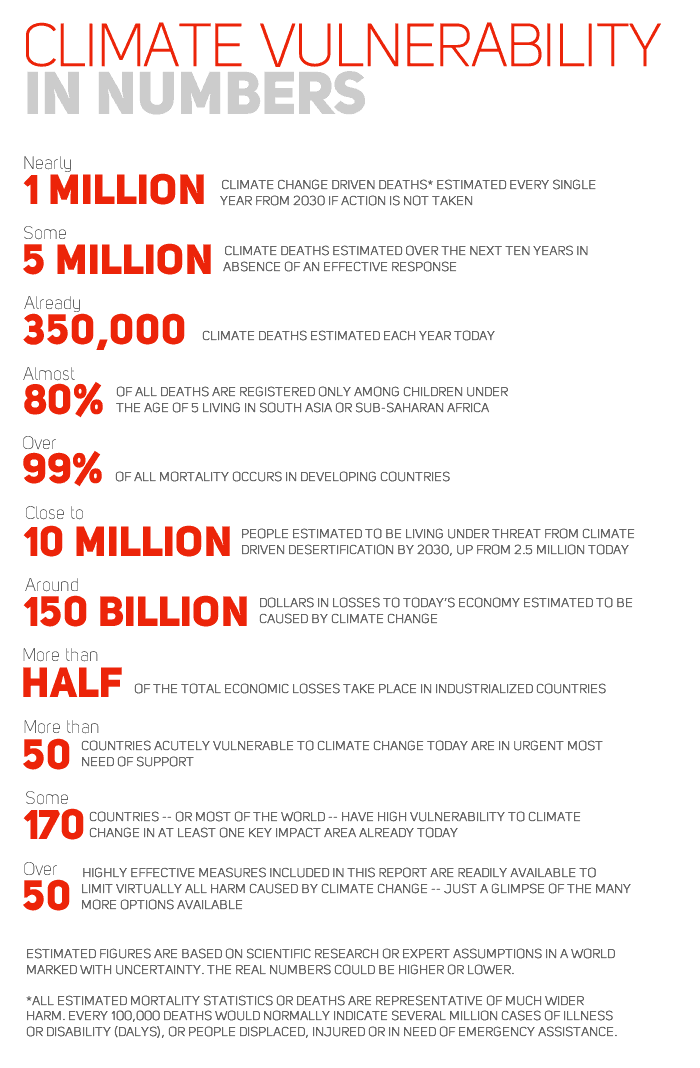
Climate Crisis Fact of the Day

Globally, estimated economic stresses due to climate change point to losses of USD 63 billion each year today. This impact will rise by more than 100% to USD 157 billion each year by 2030.

More Climate Vulnerability Monitor 2010

Thursday, November 25, 2010

Timor Leste Budget Time Table


An aggregate fiscal envelope for the budget year and fiscal envelopes by line
ministries and main economic expenditure categories are set annually; changes from
year to year are mainly incremental with few adjustments to reflect the changing
government priorities. In May, the MOF prepares the fiscal envelopes based on the macroeconomic projections and national priorities. The allocation of aggregate fiscal envelope between recurrent and capital
budget is not based on a clearly defined methodology, and the capital budget fiscal envelope
is not allocated to the line ministries individually. Both aggregate and detailed fiscal
envelopes are discussed and endorsed by the COM, followed by the issuance of instructions
in the budget circular to the Organs of State12 to submit their capital budget projects by mid-
June and recurrent budget proposals by end-June. The circular provides guidelines on the
preparation of annual action plans (AAPs), capital projects, new initiatives, and includes
fiscal envelopes of recurrent budgets by line ministries. The MOF provides the unit costs for
formulation of certain expenditures as supplementary guidelines. Line ministries generally
submit budget requests above the provided fiscal envelopes; in 2009, the requests were on
average 35 percent higher.

Timor-Leste, PFM consultants heaven!

Democratic Republic of Timor-Leste: Public Financial Management-Performance Report
Timor-Leste: Report on Observance of Standards and Codes (ROSC)-Fiscal Transparency Module

Highlights from the ROSC;
There is no clear and simple citizen’s guide to the budget.

 Short term recommendations;
  • Initiate identification and costing of new government initiatives in the budget, both on the expenditure and revenue side, and identify recurring costs of public investment for the medium term. (2.1.3 paragraph 40)
  • Require donors to provide estimates of planned expenditure volumes on a multiyear basis (but not on individual projects), and include these in the multiyear fiscal presentation and the expenditure projections in the budget. (2.1.5 paragraph 47)
  • Start building capacity in costing and analytic review of capital projects and program expenditure. (2.1.1 paragraph 34)
  • Include in the budget documents analysis of revenue and expenditure outturns compared to plan, for the three prior years to the budget year. (3.1.2 paragraph 63)
  • Publish a clear and simple summary guide to the budget in Tetum and Portuguese to inform the population. (3.2.1 paragraph 72)
  • Specify in the financial regulations the process and conditions for the access to contingency reserve funds to prevent use for other purposes. (2.2.3 paragraph 55)

 Medium Term Recommendations;
-Strengthen capacity in basic macrofiscal forecasting and use of the financial programming model. Document the macroeconomic framework. Basic macroeconomic assumptions underlying the budget estimates should be published at an early stage of the budget cycle and clearly presented in the budget documents. Extend the macrofiscal framework towards the medium term by estimating the main revenue and expenditure flows over the medium term; develop of a medium-term fiscal framework. (2.1.2 paragraphs 36 and 37)
-Develop a medium-term PIP with clear principles for the evaluation, prioritization, and approval of investment projects. Capacity building and/or buying in cost-benefit analysis in the context of multiyear investment projects is essential. (2.1.1 paragraph
34)
- Include in the timeline for budget preparation an extended period for line ministries to prepare and for the MOF to analyze and discuss the rationale and costing of the budget. For the latter, additional review capacity in MOF is needed to verify costing and challenge the recurrent and capital project budget submissions requests and correspondent links. (2.1.1 paragraph 35)
-Review and further develop the program classification of expenditure and better link it to line ministry policies; use it initially for budget planning and presentational purposes; extend the functional classification to include subfunctions and items.(3.2.2 paragraph 73)
-Strengthen the strategic planning capacity in the prime minister’s office, MOF, and line ministries, and establish clear links to the AAPs and line ministries’ budgets and
include in budget documents additional analysis on government priorities, programs, and targets. (3.2.4 paragraph 74)
-Cost existing policies and clearly separate them from new policies in the preparation of budget and forward estimates. This would enable the presentation of “baseline” expenditures at the start of the budget process. (2.1.3 paragraph 39)
-Develop a more robust methodology to expand production of baseline and budget estimates over the medium term.
-Decide on line ministry expenditure ceilings in the COM at the start of the budget cycle on the basis of baseline estimates, new expenditure initiatives and possible savings targets. These ceilings should be provided to line ministries in the budget circular, and cover both recurrent and capital expenditure
-Develop presentations in the budget in the following areas: fiscal risks, quasi-fiscal activities (including by petroleum companies), and contingent liabilities. (3.1.3 paragraph 66);
-Develop an overview of existing and new tax expenditures in the budget. (1.2.1 paragraph 22)
-The MOF should develop or commission occasional reports on long term expenditure and revenue trends. Such analyses would provide a good framework to address structural issues like population growth and the costs associated with this, or the limitations of natural resources. This would be particularly important in the preparation of the Vision 2020 plan update. (3.2.4 paragraph 74)

Quote of the Day- On the Quality of Budget Speeches

The budget speech was additionally turned into a management tool by Yashwant Sinha. Every sentence of the budget speech is put into a spreadsheet, responsibility for implementation is assigned, and quarterly reports are produced about progress of implementation. Through this, the budget speech has become the workplan of government for the year. What gets announced in the budget speech tends to get done. Few things get done in the year other than what is announced in the budget speech.
- Ajah Shah, Which type of budget speech is this?

Sri Lanka Budget 2011

Skimming through Sri Lanka budget speech;

-I undertook a Pre Budget Review of all 25 districts and provincial level work. I wish to share some evidence of progress. Sri Lanka’s poverty which was 15.2 percent in 2006 has declined to 7.6 percent in 2010. Most important development is that poverty in rural areas has declined from 15.7 percent to 7.6 percent while in the estate areas, it has declined from 32 percent to 9.2 percent. We will direct our strategies to reduce poverty below 5 percent within the next 5 years...

-All island unemployment which was 7.2 percent in 2005 has dropped to 5.8
percent by 2009.
In addition, earnings of our farmers and the labour force have increased. In 2005, farmers could not secure even Rs.10 for a kilo of paddy they produced. We managed to maintain it in the range of Rs. 24 – 28 per kilo.

-Our country is ranked first in the world in the health and survival indicators, sixth in the political empowerment indicators and among the top 20 in the world in gender equality indicators as well as a location attractive for outsourcing. Our performance in education and health is above average.

-The export potential of value added, branded exports has been estimated in excess of US$ 5 billion over the medium term.

-Tourism should be a billion dollar business. Although
tourist arrivals have picked up and expected to be around 600,000 this year, earnings from tourism shows only a moderate increase. This is largely because the industry as a whole is underpriced. Therefore, I propose to impose a levy of US$ 20 per bed on all five star hotels which charge a room rate that is less than US$ 125 per night from January 2011 in order to compel all hotels to charge better rates.

-We must get ready to facilitate 2.5 million high spending tourists by 2016. Tourists must see our richness and diversity. Over the next few years the capacity of this industry need to be tripled from the current level of around 15,000 rooms.

-Sri Lanka is fast emerging as a niche global destination attracting outsourcing of IT and BPO services. It has become the fifth largest exporter. At present, the country is ranked seventh among the 50 best emerging global cities that attract outsourcing...The Government has launched various programs to increase ICT literacy to 75 percent by 2016.Our aim is to make this industry a US$ 2 billion export activity by 2016.

-our key goal in this decade of development is to improve our productivity by 5-6 percent per annum.

-SriLankan Airline and Mihin Lanka will be expanded with new aircrafts to increase the fleet to 30 by 2012. I propose to exempt SriLankan and Mihin Lanka from all taxes for a period of 10 years to strengthen the two enterprise

-nearly 3 million Sri Lankans are engaged in overseas employment.
The remittance income to the country is expected to be nearly US$ 4 billion this year. However, there is no proper social security system for these people when they reach old age. Therefore, I propose to set up an Overseas Employees’ Pension Fund (OEPF).

-My attempt in this Budget is to sustain our achievements and manage future risks in our economy. We have achieved an economic growth rate of near 8 percent. Inflation has stabilized at around 6 percent. Poverty has come down to 7.6 percent and unemployment to 5 percent. These are all achievements within 5 years. This argues well in favour of our development strategy. The Central Bank has built up US$7 billion reserves. Our banking system has a further US$ 1.5 billion. So the economy has sufficient external assets. All these are achievements that all of us must be proud of. A low rate of inflation of around 5-6 percent, economic growth rate of around 7-8 percent and a society free from poverty are our medium term targets.

-raising income beyond US$ 4,000 per capita is not the only objective in our strategy. People need equitable opportunities to enjoy such high income.

For Discussion
: How do you rate this budget speech?

Related:
Budget Speech 2011

2011 budget to introduce fiscal reforms
"The 7.5 percent budget deficit target should be achieved comfortably
as the expenditure would be the same like last year and the revenue is
picking up," Jayasundera said. He said economic growth would be close
to 7 percent, as earlier forecast.

"The reserves are more than the IMF target. I am optimistic of the IMF
releasing both the third and fourth tranche together," he said.

Jayasundara said he expects tourism revenue to grow to $1 billion
annually from its present $400 million, and foreign direct investment
to boom to $1.5-2 billion annually from around $600 million now
.

He said foreign investment inflows should put upward pressure on the
rupee currency. "I see a higher probability for appreciation than
depreciation," he said.
The six areas where the budget speech has to deliver
Core public goods are international relations, defence, police and judiciary. These are the foundations of civilised existence. They are pure public goods in that everyone benefits when these are done properly. When law and order conditions are good, a new born child benefits from these without imposing any new cost upon the country.

Thursday, November 11, 2010

The Deficit Commission and Enactment Strategies

For Discussion- Should Public Commissions include concrete implementation strategies in their reports as David Brooks alleges below;

The report from the chairmen lists some of the best ways to raise revenue and cut spending. But it comes with no enactment strategy. In this climate, asking politicians to end the mortgage deduction and tax employer health care plans and raise capital gains taxes and cut benefits for affluent seniors is like asking them to jump on a buzzing sack full of live grenades. They won’t do it.

Related:
Deficit commission leaders are not addressing the root causes of the long-term deficit

The PowerPoint

So, About That Deficit Commission ...
Tax revenues capped at 21% of GDP

The deficit commission report
Mankiw is happy, Krugman and DeLong are upset.

Panel Seeks Social Security Cuts and Higher Taxes

The deficit commission’s plan

Friday, September 24, 2010

Assorted on Obama's Management Agenda

Task Force on Government Performance


From Setting Goals to Achieving Them;
OMB’s budget-setting process is often seen as its primary role, with the organization’s responsibility for improving government’s management and performance taking a backseat. But the Obama administration has made clear that improving performance across agencies is important to it by appointing a chief performance officer for government and re-energizing the management side of OMB.

What Government Can Learn from the Preakness
We therefore recommend that the bill include a limit of five high-priority goals per agency or perhaps a ceiling across government of no more than 100 goals. These are priorities, after all.

Setting Goals for Government: The Senate Can Deliver This Fall


Asking Questions Like the British Do

I remember being struck by the power of the approach that Barber invented when I was working as an official in the British government back in 2001. By asking three sets of difficult but very simple questions, the Delivery Unit changed the way that we thought about our jobs. The three themes were:

What journey are you trying to make in terms of the goal? Where are you now and what’s the destination?
What’s your strategy to get there? Why do you think your interventions will work?
How will you monitor progress as you proceed? Do you have the capacity to adjust your strategy as you go along?

Wednesday, September 22, 2010

Practitioners in Economic Policy

Profile of Maria Ramos;

Maria Ramos and her Finance Department colleagues were charged with putting in front of South Africa’s ministers and cabinet viable options for reaching economic targets without jeopardizing financial stability. Ramos says nothing was sugar coated.

“In 1996 we had to put a fiscal policy in place that had to say to the nation that if we wanted to achieve a sustainable economic growth path of 6 percent, this was how we would get there. That was our starting point. People often think that the program of growth, employment, and redistribution was about cutting the deficit. That’s not the question we asked. We asked: ‘If we want 6 percent growth, what do we need to have in place to achieve it?’

“Very quickly, we came to the conclusion that you can’t get to 6 percent growth when you have a position of fiscal instability, because you can’t borrow your way out of a crisis. We didn’t want to go to the IMF—we didn’t think that was going to be a sustainable solution—and we were very close to that. South Africa had no reserves—in fact we had a negative reserve position because we had a net open forward position at that point of about $26 billion. We had debt-to-GDP ratios of around 50 percent, we had debt-servicing costs reaching the point where they were unsustainably high. So the fiscal position was pretty precarious: the metrics didn’t add up.

“So if you want to get growth there, you have to fix the base. And fiscal sustainability is hard to achieve and it’s easy to lose. That’s what we placed before policymakers, before the cabinet. And I have to say that, as hard as it was, when faced with that, I never came across a politician from the president down who said: ‘No, we can’t do this because it’s going to be unpopular for me.’ What’s been remarkable for me as a civil servant to see was that politicians from the top down were able to say ‘What is in the best interests of our country? It’s going to be painful, it’s going to be hard.’ Those investments continue to pay off today.”

Random Course

Public Economics- from MIT OpenCourseWare

Tax Gap visualisatiion

This may be the most difficult diagram I've ever done. The information and data is swathed in obfuscation, economic jargon and subtle sleight-of-hand definitions and sub-definitions that mask the meaning from interested readers. It was a real struggle. I hope it and the data make sense.

Tuesday, September 21, 2010

Evaluating Government Employment and Compensation- A Primer

Just released brief from IMF.

Evaluating Government Employment and Compensation
Author/Editor: Clements, Benedict J. , Gupta, Sanjeev . Karpowicz, I. , Tareq, Shamsuddin

Related:
Wage Policy and Fiscal Sustainability in Benin

Kiribati: 2009 Article IV Consultation - Staff Report

Kenya: Selected Issues and Statistical Appendix

How to Praise a Finance Minister

"The observed resilience of the Mauritian economy is a testimony to the positive impact of the reforms carried out since 2006, which favoured economic diversification and adaptation at the same time that it created fiscal space for expansionary macroeconomic policies and other innovative, timely, temporary and targeted responses to cushion the crisis impact".
-World Bank, Mr Fabiano Bastos, quoted in the Budget Speech

Random thoughts on Improving PFM Technical Assistance

'The best solutions are those where international experience is judiciously mixed with local genius'-Suhas Joshi

Some more comments on Richard Allen's post about improving effectiveness of PFM TAs';

- I don't see any problems in moving towards what locals and advisers see as best practice; as long we consider that there are many recipes of 'best practice'

-TA reports should always start the dialogue, but how does one institutionalise discussion and follow up of TA reports on PFM? Which committees should be responsible, and at which level?

- Mr. Joshi also makes importance points in the comments-'countries therefore do not need large prescriptive reports but help is resolving the constraints they have'. I fully agree, 'it is more useful to have as a TA someone who understands the country and has spent some time there'

- One of the biggest problems I've seen are consultants who want to take you for a ride- this is a problem for assistance provided by some international donors who have weak internal expertise, exceptions include World Bank and IMF. Countries need to seriously think the donor they approach for reform PFM areas and whether they have a comparative advantage in them.

Putting Foreign Aid in Macro-Fiscal Frameworks

I found the following from the Mauritius budget call circular to be useful- putting aid into overall sectoral ceiling is really a feature of mature MTEF. Mauritius budget process is certainly very advanced.

Financial resources expected from development partners (grant or loan funding) have already been factored in the macro-fiscal framework used for working out spending limits and do not therefore constitute an additional source of funds available for spending.

For Discussion: How's foreign aid incorporated in MTEF's in other countries like Albania, which have mature MTEF's?

Related:
Albania- Albania Public Expenditure and Institutional Review 2001


REPIM

Monday, September 20, 2010

MDG T-Shirt Ideas

Source: you know from whom

Economic Growth Officers' Conference

Didn't know USAID had economic growth officers- I wonder what Prof. Easterly would say about it. Anyway I have collated some of the the podcasts of the sessions below- Romer's session is highly recommended.

Technology Drive Growth, Rules Drive Development
Paul Romer, Stanford University
Steve Radelet, Department of State

The Millennium Development Goals: The Road to 2015

Global Climate Change: Impact on Agriculture and Costs of Adaptation

Global Climate Change: Leveraging Investment Flows for Mitigation

Reinventing Government: Designing Programs to Enhance Public Sector Effectiveness and Performance
H.E. Minister Imad Fakhoury, Ministry of Public Sector Development, Government of the Hashemite Kingdom of Jordan
Ms. Widad Qutaishat, Results-Oriented Government Component Lead, USAID/Jordan Fiscal Reform II Project, DAI
Dr. Emil Bolongaita, Director, Management Systems International
Moderator: Dr. Mark Gallagher, Chief of Party, USAID/Jordan Fiscal Reform II Project, DAI

A Behavioral Approach to Economic Development
Sendhil Mullainathan, Poverty Action Lab and Harvard University
Michael Kremer, Harvard University

Government ICT Applications that Save Businesses Time and Money
Valentina Mintah, Crown Agents
Efrain Laureano, Chemonics International
Judy Payne, USAID/EGAT/I&E/ICT

Accelerating Job Creation and Growth
Steve Kapsos, ILO/Geneva
Mary Hobbs, USAID/Kosovo
Eduardo Tugendhat, CARANA Corporation
Lili Stern, U.S. Department of Labor

Access to Innovative Financial Services

World Bank’s Doing Business Indicators: Lessons Learned and New Directions
Svetlana Baguadinova, Doing Business Project, The World Bank
Rita Ramalho, Enterprise Analysis Unit, The World Bank
Carolin Geginat, The World Bank

Monitoring and Evaluation for Economic Growth

Shared Growth Diagnostics: Finding the Binding Constraint to Growth and Poverty Reduction

USAID Economic Growth Programming: Ultimate Impacts

Assorted

Anti-disorder campaigns can change urban norms;
Part of what people like about New Delhi’s metro is that the cars are clean and people are relatively courteous. Some riders are so pleased, in fact, that they volunteer their time to ensure it stays that way. They enforce rules against public spitting and urination. Though such rules are routinely ignored in the rest of the city, the volunteers appear to be winning the battle so far to sustain new norms among metro riders.

Even when cities enforce formal rules against certain kinds of behavior, creating a culture of compliance with the rules can be challenging. The Delhi metro monitors are simply trying to preserve a desirable equilibrium.
-How The Times built teacher effectiveness database