The government announced the establishment of the Irish Fiscal Advisory Council (IFAC) on July 7, 2011. The IFAC is mandated to provide an assessment of:-Ireland: Third Review Under the Extended Arrangement - Staff Report
(i) the soundness of official macro-fiscal forecasts;
(ii) the appropriateness of the fiscal stance (including the government’s stated medium-term budgetary objective); and(iii) the consistency between budgetary plans and fiscal rules (the latter are to be specified in a Fiscal Responsibility Bill by year-end).
The IFAC will submit, at least three times a year, written reports to the Minister for Finance, which will automatically be communicated to the Oireachtas within 24 hours. This effectively means that the IFAC’s reports are published with the Minister having advance notice of their content. There are no restrictions, otherwise, on the Council’s communication with the public.
The IFAC comprises five members, appointed by the Minister for Finance for initial tenures of two to four years. The members will serve in a voluntary capacity, assisted by a small secretariat including full-time economist staff. The Council has been allocated initial funding for the remainder of 2011.
Among the range of fiscal councils in Europe, the IFAC appears most similar to the Swedish Fiscal Policy Council, both in terms of mandate and funding. For instance, the IFAC is charged with assessing, rather than producing, the official macro-fiscal forecasts, which explains its relatively modest resources compared with say, the U.K.’s Office for Budget Responsibility
Showing posts with label Small States. Show all posts
Showing posts with label Small States. Show all posts
Thursday, September 8, 2011
Irish Fiscal Advisory Council

Wednesday, August 31, 2011
Mauritius PEFA update
Mauritius appears to have done an update of its PEFA;
Mauritius continues to perform well against the PEFA benchmarks. The scores show progress compared to the 2007 PEFA assessment, with 27 out of the 31 reported ratings higher or equal to those obtained in 2007...
Comprehensiveness and transparency have improved since the last PEFA
assessment. The budget classification system adopted for the 2008-09 budget, which incorporates a program budget approach for the first time, is based on the IMF Government Finance Statistics Manual (GFSM) 2001. Budget documentation is relatively comprehensive, meeting seven out of nine of the required benchmarks. However, the analysis and discussion of macro-fiscal projections and fiscal outputs are limited, and transactions between the central government and extra-budgetary units are not fully reported
The monitoring of fiscal risks has been progressively strengthened over the
reporting period, though gaps still remain. Monitoring and reporting of fiscal risks is not always systematic and coverage remains incomplete―financial institutions and extra-budgetary units are not monitored. Budget integrity is in general sound, with some remaining issues in the monitoring and publication of contract awards and the tracking of flows of funds to primary service delivery units.
A clear annual budget calendar exists and is largely adhered to. The budget
circular provides the guidance necessary for line ministries to prepare a complete and detailed budget submission. However, strategic planning capacity in government remains limited and the links between macroeconomic projections, fiscal strategy, ministry-level strategic plans, and the budget process require strengthening. In particular, insufficient time is available at the early stages of the budget process for discussions between line ministries and the Ministry of Finance and Economic Development (MoFED) to determine strategic priorities within the fiscal framework. This is particularly apparent on the capital side of the budget, where significant capacity constraints result in substantial underspending.


Saturday, May 21, 2011

Sunday, February 20, 2011
The Singapore Way


Related:
If Singapore has one thing to teach America, it is about taking governing seriously, relentlessly asking: What world are we living in and how do we adapt to thrive. “We’re like someone living in a hut without any insulation,” explained Tan Kong Yam, an economist. “We feel every change in the wind or the temperature and have to adapt. You Americans are still living in a brick house with central heating and don’t have to be so responsive.” And we have not been
Saturday, January 8, 2011
Cascading Peformance Agreements
For Discussion: Which type of performance arrangements is best suited for a small island developing countries?


Source: Performance-based Arrangements for Senior Civil Servants: OECD and Other Country Experiences


Source: Performance-based Arrangements for Senior Civil Servants: OECD and Other Country Experiences
Friday, December 10, 2010
Climate Crisis Fact of the Day
Globally, estimated economic stresses due to climate change point to losses of USD 63 billion each year today. This impact will rise by more than 100% to USD 157 billion each year by 2030.
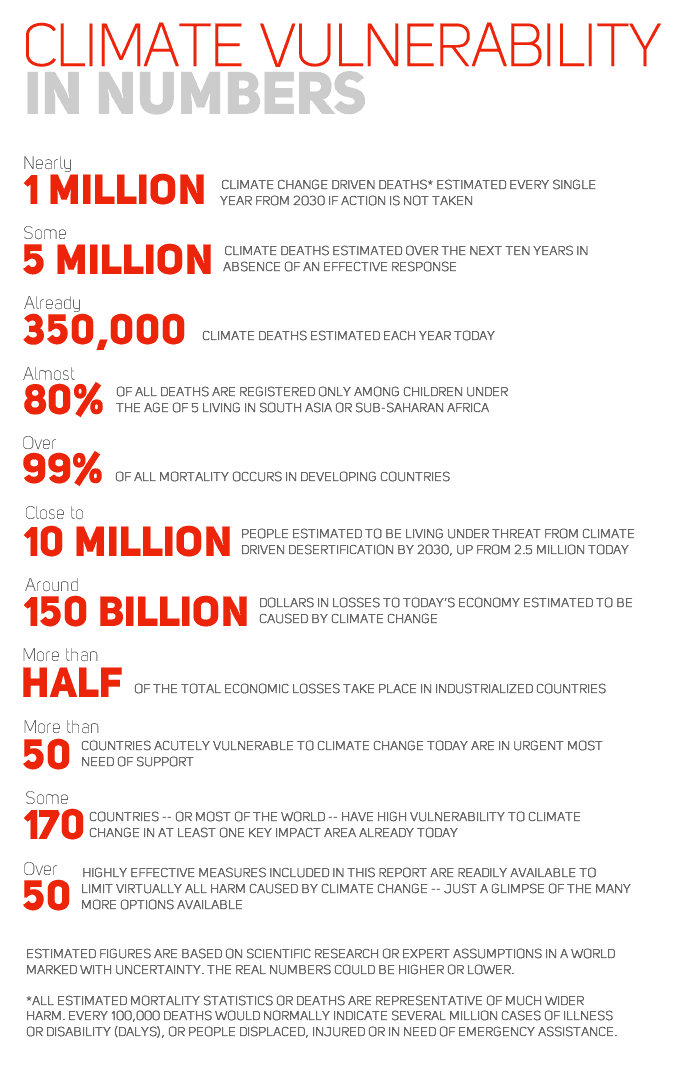
More Climate Vulnerability Monitor 2010
Thursday, November 25, 2010
Timor Leste Budget Time Table

An aggregate fiscal envelope for the budget year and fiscal envelopes by line
ministries and main economic expenditure categories are set annually; changes from
year to year are mainly incremental with few adjustments to reflect the changing
government priorities. In May, the MOF prepares the fiscal envelopes based on the macroeconomic projections and national priorities. The allocation of aggregate fiscal envelope between recurrent and capital
budget is not based on a clearly defined methodology, and the capital budget fiscal envelope
is not allocated to the line ministries individually. Both aggregate and detailed fiscal
envelopes are discussed and endorsed by the COM, followed by the issuance of instructions
in the budget circular to the Organs of State12 to submit their capital budget projects by mid-
June and recurrent budget proposals by end-June. The circular provides guidelines on the
preparation of annual action plans (AAPs), capital projects, new initiatives, and includes
fiscal envelopes of recurrent budgets by line ministries. The MOF provides the unit costs for
formulation of certain expenditures as supplementary guidelines. Line ministries generally
submit budget requests above the provided fiscal envelopes; in 2009, the requests were on
average 35 percent higher.
Timor-Leste, PFM consultants heaven!
Democratic Republic of Timor-Leste: Public Financial Management-Performance Report
Timor-Leste: Report on Observance of Standards and Codes (ROSC)-Fiscal Transparency Module
Highlights from the ROSC;
-Develop a medium-term PIP with clear principles for the evaluation, prioritization, and approval of investment projects. Capacity building and/or buying in cost-benefit analysis in the context of multiyear investment projects is essential. (2.1.1 paragraph
34)
- Include in the timeline for budget preparation an extended period for line ministries to prepare and for the MOF to analyze and discuss the rationale and costing of the budget. For the latter, additional review capacity in MOF is needed to verify costing and challenge the recurrent and capital project budget submissions requests and correspondent links. (2.1.1 paragraph 35)
-Review and further develop the program classification of expenditure and better link it to line ministry policies; use it initially for budget planning and presentational purposes; extend the functional classification to include subfunctions and items.(3.2.2 paragraph 73)
-Strengthen the strategic planning capacity in the prime minister’s office, MOF, and line ministries, and establish clear links to the AAPs and line ministries’ budgets and
include in budget documents additional analysis on government priorities, programs, and targets. (3.2.4 paragraph 74)
-Cost existing policies and clearly separate them from new policies in the preparation of budget and forward estimates. This would enable the presentation of “baseline” expenditures at the start of the budget process. (2.1.3 paragraph 39)
-Develop a more robust methodology to expand production of baseline and budget estimates over the medium term.
-Decide on line ministry expenditure ceilings in the COM at the start of the budget cycle on the basis of baseline estimates, new expenditure initiatives and possible savings targets. These ceilings should be provided to line ministries in the budget circular, and cover both recurrent and capital expenditure
-Develop presentations in the budget in the following areas: fiscal risks, quasi-fiscal activities (including by petroleum companies), and contingent liabilities. (3.1.3 paragraph 66);
-Develop an overview of existing and new tax expenditures in the budget. (1.2.1 paragraph 22)
-The MOF should develop or commission occasional reports on long term expenditure and revenue trends. Such analyses would provide a good framework to address structural issues like population growth and the costs associated with this, or the limitations of natural resources. This would be particularly important in the preparation of the Vision 2020 plan update. (3.2.4 paragraph 74)
Timor-Leste: Report on Observance of Standards and Codes (ROSC)-Fiscal Transparency Module
Highlights from the ROSC;
There is no clear and simple citizen’s guide to the budget.
Short term recommendations;
- Initiate identification and costing of new government initiatives in the budget, both on the expenditure and revenue side, and identify recurring costs of public investment for the medium term. (2.1.3 paragraph 40)
- Require donors to provide estimates of planned expenditure volumes on a multiyear basis (but not on individual projects), and include these in the multiyear fiscal presentation and the expenditure projections in the budget. (2.1.5 paragraph 47)
- Start building capacity in costing and analytic review of capital projects and program expenditure. (2.1.1 paragraph 34)
- Include in the budget documents analysis of revenue and expenditure outturns compared to plan, for the three prior years to the budget year. (3.1.2 paragraph 63)
- Publish a clear and simple summary guide to the budget in Tetum and Portuguese to inform the population. (3.2.1 paragraph 72)
- Specify in the financial regulations the process and conditions for the access to contingency reserve funds to prevent use for other purposes. (2.2.3 paragraph 55)
Medium Term Recommendations;
-Strengthen capacity in basic macrofiscal forecasting and use of the financial programming model. Document the macroeconomic framework. Basic macroeconomic assumptions underlying the budget estimates should be published at an early stage of the budget cycle and clearly presented in the budget documents. Extend the macrofiscal framework towards the medium term by estimating the main revenue and expenditure flows over the medium term; develop of a medium-term fiscal framework. (2.1.2 paragraphs 36 and 37)-Develop a medium-term PIP with clear principles for the evaluation, prioritization, and approval of investment projects. Capacity building and/or buying in cost-benefit analysis in the context of multiyear investment projects is essential. (2.1.1 paragraph
34)
- Include in the timeline for budget preparation an extended period for line ministries to prepare and for the MOF to analyze and discuss the rationale and costing of the budget. For the latter, additional review capacity in MOF is needed to verify costing and challenge the recurrent and capital project budget submissions requests and correspondent links. (2.1.1 paragraph 35)
-Review and further develop the program classification of expenditure and better link it to line ministry policies; use it initially for budget planning and presentational purposes; extend the functional classification to include subfunctions and items.(3.2.2 paragraph 73)
-Strengthen the strategic planning capacity in the prime minister’s office, MOF, and line ministries, and establish clear links to the AAPs and line ministries’ budgets and
include in budget documents additional analysis on government priorities, programs, and targets. (3.2.4 paragraph 74)
-Cost existing policies and clearly separate them from new policies in the preparation of budget and forward estimates. This would enable the presentation of “baseline” expenditures at the start of the budget process. (2.1.3 paragraph 39)
-Develop a more robust methodology to expand production of baseline and budget estimates over the medium term.
-Decide on line ministry expenditure ceilings in the COM at the start of the budget cycle on the basis of baseline estimates, new expenditure initiatives and possible savings targets. These ceilings should be provided to line ministries in the budget circular, and cover both recurrent and capital expenditure
-Develop presentations in the budget in the following areas: fiscal risks, quasi-fiscal activities (including by petroleum companies), and contingent liabilities. (3.1.3 paragraph 66);
-Develop an overview of existing and new tax expenditures in the budget. (1.2.1 paragraph 22)
-The MOF should develop or commission occasional reports on long term expenditure and revenue trends. Such analyses would provide a good framework to address structural issues like population growth and the costs associated with this, or the limitations of natural resources. This would be particularly important in the preparation of the Vision 2020 plan update. (3.2.4 paragraph 74)
Sunday, March 28, 2010
Haiti Donor Conference
Haiti Pledge Form looks quiet interesting.
More countries could use this approach in dealing with their donors.
Related: Another pledging form from a small state.
More countries could use this approach in dealing with their donors.
Related: Another pledging form from a small state.
Thursday, February 25, 2010
Marshall Islands - Civil Service Reforms


Civil service rationalization. The public sector wage bill has doubled since 2000 primarily due to a rise in the public payroll and, at 22 percent of GDP, is significantly higher than in other countries in the region. The mission welcomed the plan to conduct a comprehensive civil service personnel audit to identify areas of over-staffing and disproportionate pay. Building on the audit’s findings, a combination of civil service pay cuts and reductions in employment should be phased over the near term.
Related:
Doing Business
Friday, January 8, 2010
Recently from World Bank
Malaysia economic monitor : repositioning for growth
Syrian Arab Republic - Electricity sector strategy note
Azerbaijan - Country economic memorandum : a new silk road - export-led diversification
Lithuania - Social sectors public expenditure review
Tanzania - Public expenditure review of the water sector
Mexico - Agriculture and rural development public expenditure review
Doing privatization right
Public-Private Partnership units : what are they, and what do they do
Reform teams
Seychelles - Public expenditure review
Legal frameworks for tertiary education in Sub-Saharan Africa : the quest for institutional responsiveness
Comparing European and U.S. securities regulations : MiFID versus corresponding U.S. regulations
Accounting for growth in Latin America and the Caribbean : improving corporate financial reporting to support regional economic development
Uzbekistan - Assessment of the primary health care reform : transparency, accountability, and efficiency
Organization of Eastern Caribbean States - Increasing linkages of tourism with the agriculture, manufacturing, and service sectors
The Afghanistan investment climate in 2008 : growth despite poor governance, weak factor markets, and lack of innovation
Costa Rica - Competitiveness diagnostic and recommendations
Syrian Arab Republic - Electricity sector strategy note
Azerbaijan - Country economic memorandum : a new silk road - export-led diversification
Lithuania - Social sectors public expenditure review
Tanzania - Public expenditure review of the water sector
Mexico - Agriculture and rural development public expenditure review
Doing privatization right
Public-Private Partnership units : what are they, and what do they do
Reform teams
Seychelles - Public expenditure review
Legal frameworks for tertiary education in Sub-Saharan Africa : the quest for institutional responsiveness
Comparing European and U.S. securities regulations : MiFID versus corresponding U.S. regulations
Accounting for growth in Latin America and the Caribbean : improving corporate financial reporting to support regional economic development
Uzbekistan - Assessment of the primary health care reform : transparency, accountability, and efficiency
Organization of Eastern Caribbean States - Increasing linkages of tourism with the agriculture, manufacturing, and service sectors
The Afghanistan investment climate in 2008 : growth despite poor governance, weak factor markets, and lack of innovation
Costa Rica - Competitiveness diagnostic and recommendations
Monday, January 4, 2010
Books about Iceland
Why Iceland?: How One of the World’s Smallest Countries Became the Meltdown’s Biggest Casualty by Asgeir Jonsson
Frozen Assets: How I Lived Iceland’s Boom and Bust, by Armann Thorvaldsson,
Meltdown Iceland: Lessons on the World Financial Crisis from a Small Bankrupt Island
-Roger Boyes
Frozen Assets: How I Lived Iceland’s Boom and Bust, by Armann Thorvaldsson,
Meltdown Iceland: Lessons on the World Financial Crisis from a Small Bankrupt Island
-Roger Boyes
Monday, December 28, 2009
Monday, September 28, 2009
By a Consultant for another Consultant?
Senior Budget Adviser- Timor Leste (deadline October 6)
From the scope of work;
I've to say good luck to the Budget Adviser.
Related;
Timor-Leste PEFA
A Balancing Act: Implementation of the Paris Declaration in Timor-Leste
East Timor- AUSAID
Timor-Leste: Reflections on the 10th anniversary of independence
Timor-Leste-World Bank
From the scope of work;
-Where requested, report to and advise the Senior Management and on matters of budget design and execution;
-Develop the management and leadership skills of the National Director, focusing in particular on:
clear comprehension of his core roles and responsibilities;
identifying how directorate workflows fit into these roles and responsibilities;
effective delegation;
realistic workload assessment and planning; and
inculcating some basic concepts of team-building.
-Support the development and execution of the national budget in line with the budget guidelines;
-Assist in the integration of the services provided by the Ministry to Line Ministries in the areas of budgeting, planning, treasury functions and procurement.
-Build capacity within the budget and expenditure review units with a view to, over time, a greater percentage of the work of the units can be undertaken independently by national staff,
-Build the capacity of local staff to oversee the management of line Ministry budget processes;
-Support the development of new systems and processes as the budget design is gradually computerised onto the FMIS and devolved to line agencies;
-Provide advice and support to the implementation of the performance budgeting element of the FMIS;
-To instill and further develop a client focus culture in the budget and expenditure review units.
-Provide advice on the budgetary impacts of various government initiatives to the Minister for Finance;
-Provide holistic/ strategic advice on ministry issues, as requested; and,
-In consultation with the Professional Development Program director, identify training needs for staff in the National Directorate of the Budget and Planning and develop strategies to secure the necessary skills needed to ensure the long term viability of the National Budget Directorate.
-Perform such other technical and inline functions as may be required by the Program Services Directorate or the Ministry of Finance.
I've to say good luck to the Budget Adviser.
Related;
Timor-Leste PEFA
A Balancing Act: Implementation of the Paris Declaration in Timor-Leste
East Timor- AUSAID
Timor-Leste: Reflections on the 10th anniversary of independence
Timor-Leste-World Bank
Friday, May 1, 2009
More roles for the World Bank in Africa
Economic policy in Africa in light of the crisis- I would recommend Ali Mansoor's ( Mauritius finance secretary) comments;
Shanta has more.
- Emphasis on O&M
- Countercyclical social Safety nets
- Invest on environment
- Mauritius approach to restructuring firms during the crisis
-IFC needs to be more proactive
Shanta has more.
Sunday, April 12, 2009
Singapore helps Lao in PFM
Singapore’s best practices in treasury, tax and customs will be shared with senior policy makers and officials from Lao PDR in a two-year capacity-building programme supported by Temasek Foundation, Singapore Cooperation Enterprise and the World Bank, in partnership with the Ministry of Finance, Lao PDR. There will be policy roundtable discussions and workshops to enable the policy makers and treasury, tax and customs officers to acquire new knowledge and skills.
Ex-senior officials from the Inland Revenue Authority of Singapore, Singapore Customs and the Ministry of Finance of Singapore will be roped in to share their experience, and help Lao’s Ministry of Finance to adapt best practices in policies, systems and processes to the Lao context.
Temasek Foundation is supporting the programme with a S$1.15 million grant, with additional funding by World Bank at S$950,000
The Ministry of Finance of the Lao People’s Democratic Republic to Tap Into Singapore’s Expertise in Public Finance Modernisation and Governance;
This is the first ever tripartite collaboration between SCE, WB and Temasek Foundation. Increasing, International Organisations (IOs) have approached SCE to share Singapore’s developmental experience with their client countries.
Mr. Alphonsus Chia, Chief Executive Officer of SCE added: “We are happy that Singapore’s developmental experience has been recognised by International Organisations (IOs) like the World Bank and Temasek Foundation. SCE is pleased to partner the IOs to participate in more public sector led projects in this region. We hope that this programme will lead to more collaboration between Singapore and Lao PDR. Through greater understanding of the needs of the foreign governments and the types of expertise available, SCE hopes to contribute more meaningfully in development projects.”
Tuesday, March 24, 2009
Sunday, February 15, 2009
South Asia-Indicators and Analysis of the Commercial Banking Sector;
Getting Finance in South Asia 2009: Indicators and Analysis of the Commercial Banking Sector;
On January 27th, 2009, the World Bank in association with the Info Shop, presented an event and panel discussion in honor of the new book by Kiatchai Sophastienphong and Anoma Kulathunga, entitled Getting Finance in South Asia 2009: Indicators and Analysis of the Commercial Banking Sector . This new volume of literature, accompanied by a CD-ROM, has provided indicators about the commercial banking sector in Bangladesh, India, Nepal, Pakistan and Sri Lanka. Additionally, the book analyzed data in area such as access to finance, performance and efficiency, financial stability, capital market development, marketing concentration and competiveness and corporate governance.
Event Chair Ernesto May opened the event by commenting on the importance of this volume in relation to the current world financial crisis as a vehicle for better understanding the health of financial sectors within these countries and the region as a whole. Next, author Kiatchai Sophastienphong presented on the objectives, background, and findings of the study. Sophastienphong commented that the study actually began in 2002 as a stop-gap measure; however, the project has evolved ever since. He also explained that concerning the next edition, the team plans to expand their data collection to include Afghanistan, Bhutan and Maldives. Co-author Anoma Kulathinga then presented on the methodology concerning data collection and how the information was divided into six separate dimensions.
Sunday, January 25, 2009
The Role for Counter-Cyclical Fiscal Policy in Singapore
The Role for Counter-Cyclical Fiscal Policy in Singapore
Summary: Singapore's policymakers have often used fiscal policy as a counter-cyclical tool. Empirical results based on a structural autoregression framework suggest that fiscal policy can be used for demand management, although the impact may be somewhat short lived. The short-lived impact could reflect a number of factors, including the absence of credit-constrained economic agents, a high propensity to save among households, monetary focus on price stability, and leakages due to economic openness. Notwithstanding, fiscal policy should still play a key stabilizing role in the current downturn given the downside risks to growth and the vast fiscal space.
Saturday, January 17, 2009
Publi Financial Management reforms in Cape Verde
The Cape Verdean authorities consider it a priority to strengthen debt management.
Notable progress has already been made:
• Debt sustainability analyses (DSAs) are now conducted annually. The Ministry of Finance and the Bank of Cape Verde (BCV) recently conducted a joint DSA applying the Bank-Fund Debt Sustainability Framework. The exercise benefited from assistance from Debt Relief International (DRI) and UNDP. The next DSA will be conducted in early 2009 at the beginning of the preparation of the 2010 budget to help determine the borrowing envelope consistent with debt sustainability.
• Internal controls have been substantially improved. Software from the Commonwealth Secretariat was upgraded and now records state guarantees as well as debt. With the assistance of the Crown Agents, the system will be fully operational by year-end. The software will allow for currency decomposition of the debt stock, be linked to the Government’s Financial Control Network (SIGOF), and allow for compilation of debt data in the new chart of public accounts (PNCP).
The authorities intend to further strengthen their debt management practices:
• The institutional framework for debt management will be adapted. The organic law of the Ministry of Finance will be amended to give the debt management office a clear mandate, and the budget execution law will be changed to allow the Treasury to manage debt efficiently.
• A new debt management strategy will be embedded in the procedures manual of the debt management office.
• The domestic market for Treasury securities will be developed. With MCC financing, Treasury securities will be easily available for purchase by nonbanks to make the market more efficient and liquid and reduce borrowing costs.
• Capacity in the debt office will be reinforced. A new financial analyst was hired in September, and another will be hired in 2009. Portugal trained four staff in debt management in September.
Source;Cape Verde: Fifth Review Under the Policy Support Instrument - Staff Report
Subscribe to:
Posts (Atom)


