Source: Skills, Not Just Diplomas-Managing Education for Results in Eastern Europe and Central Asia [October 2011]a recent survey of university students in several ECA countries found that more than 60 percent of respondents knew other students who had purchased either entrance to the university or a specific grade
Showing posts with label Reports_Books. Show all posts
Showing posts with label Reports_Books. Show all posts
Sunday, November 13, 2011
Bribery for Grade in Eastern Europe


Monday, September 26, 2011
Performance Auditing Best Practice
Climate Engineering: Technical Status, Future Directions, and Potential Responses;
Climate engineering technologies do not now offer a viable response to global climate change. Experts advocating research to develop and evaluate the technologies believe that research on these technologies is urgently needed or would provide an insurance policy against worst case climate scenarios--but caution that the misuse of research could bring new risks. Government reports and the literature suggest that research progress will require not only technology studies but also efforts to improve climate models and data. The technologies being proposed have been categorized as carbon dioxide removal (CDR) and solar radiation management (SRM). CDR would reduce the atmospheric concentration of CO2, allowing more heat to escape and thus cooling the Earth. For example, proposed CDR technologies include enhancing the uptake of CO2 in oceans and forests and capturing CO2 from air chemically for storage underground. SRM technologies would place reflective material in space or in Earth's atmosphere to scatter or reflect sunlight (for example, by injecting sulfate aerosols into the stratosphere to scatter incoming solar radiation or brightening clouds) or would increase the planet's reflectivity (for example, by painting roofs and pavements in light colors). GAO found these technologies currently immature, many with potentially negative consequences. Some studies say, for example, that stratospheric aerosols might greatly reduce summer precipitation in places such as India and northern China. Many experts advocated research because of its potential benefits but also recognized its risks. For example, a country might unilaterally deploy a technology with a transboundary effect. Research advocates emphasized the need for risk management, envisioning a federal research effort that would (1) focus internationally on transparency and cooperation, given transboundary effects; (2) enable the public and national leaders to consider issues before they become crises; and (3) anticipate opportunities and risks. A small number of those we consulted opposed research; they anticipated major technology risks or limited future climate change. Based on GAO's survey, a majority of U.S. adults are not familiar with climate engineering. When given information on the technologies, they tend to be open to research but concerned about safety.
Thursday, February 10, 2011
Social Impact Bonds or PPP Reinvented?

David Cameron’s Conservative government in Britain is already testing it, at a prison 75 miles north of London. The Bloomberg administration in New York is also considering the idea, as is the State of Massachusetts. Perhaps most notably, President Obama next week will propose setting aside $100 million for seven such pilot programs, according to an administration official.-For Federal Programs, a Taste of Market Discipline
The idea goes by one of two names: pay for success bonds or social impact bonds. Either way, nonprofit groups like foundations pay the initial money for a new program and also oversee it, with government approval. The government will reimburse them several years later, possibly with a bonus — but only if agreed-upon benchmarks show that the program is working.
Related;
A Bond to Save Lives
What Are Social-Impact Bonds?
Monday, February 7, 2011
Expenditure Tracking in India
The connection between release of funds by the Central Government and actual expenditures for physical inputs by the implementing agencies is
currently, very obscure


We highly recommend the Report of the Technology Advisory Group for Unique Projects, the chapter on Expenditure Information Network.
Friday, February 4, 2011
Friday, December 10, 2010
Climate Crisis Fact of the Day
Globally, estimated economic stresses due to climate change point to losses of USD 63 billion each year today. This impact will rise by more than 100% to USD 157 billion each year by 2030.
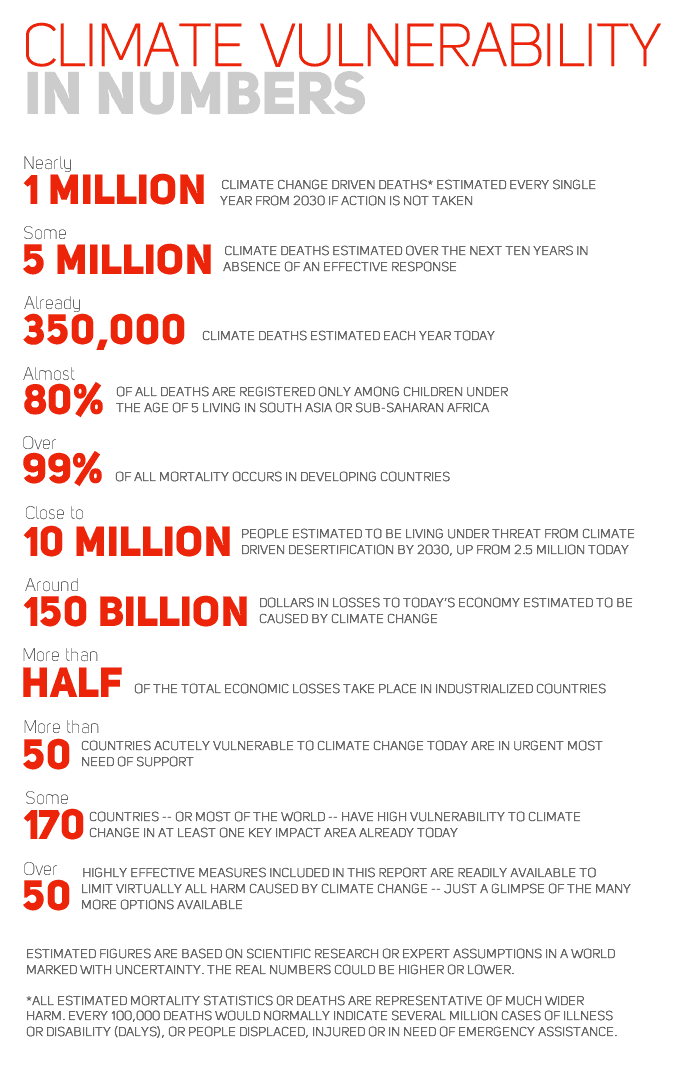
More Climate Vulnerability Monitor 2010
Friday, April 16, 2010
Efficiency what?
Efficiency savings: in recent years there has been a concerted drive to reduce the costs in commodities like electricity, to professionalise property management and to make more use of shared services. Here there is a question about control – how far should control be centralised or devolved
to best make efficiency savings. Striking the right balance is difficult, but
possible, as the Institute’s recent work on IT makes clear. The second question is about how such savings translate into cash coming out of the system – to be credible it must be clear which budgets have been reduced in anticipation of these savings, and therefore which ones have to make up any shortfall should the projected efficiencies not be realised.
Source: Undertaking a fiscal consolidation: A guide to action. Institute for Government
Related:
Mark Robsinson reviews the report;
Politics are also the reason why the real tough work required for a successful fiscal consolidation usually takes within the first two budgets after a change of government. If this doesn’t happen, the sense of urgency amongst voters dissipates. Political support for consolidation falls away rapidly, with the electorate falling prey to what the London-based Institute for Government calls – in its interesting recent report Undertaking a Fiscal Consolidation – “consolidation fatigue”.
Tuesday, March 23, 2010
Friday, March 19, 2010
Thursday, March 18, 2010
Women Fact of the Day
Only 20 of 128 economies have equal legal rights for men and women in several important areas for entrepreneurs and workers, according to a new World Bank Group report, Women, Business and the Law 2010.
Wednesday, March 10, 2010
PFM tools for the IT Age
I'm looking for examples of innovative use of government expenditure data.
Examples:
Where Does the Money Go?
Related;
Show Us a Better Way
Putting the Frontline First: Smarter Government
Examples:
Where Does the Money Go?
Related;
Show Us a Better Way
Putting the Frontline First: Smarter Government
Sunday, November 15, 2009
Assorted
2009 edition of the World Energy Outlook (WEO)
If Statisticians Could Turn Back Time
Effective Habits for writers?
New software makes it easier to fight corruption
Twenty questions for would-be MPs
Animal Spirits
International Trade Statistics 2009
Global Wage Report 2008/09: Minimum wages and collective bargaining: Towards policy coherence
Asia-Pacific Trade and Investment Report 2009 : Trade-led Recovery and Beyond
The Arab knowledge report 2009: towards productive intercommunication for knowledge
Catalysing Low Carbon Growth in Developing Economies: public finance mechanisms to scale up private sector investment in climate solutions
Addiction, Crime and Insurgency: The transnational threat of Afghan opium
Global health risks
Global Report on Human Settlements 2009: Planning Sustainable Cities
Improving Effectiveness and Outcomes for the Poor in Health, Nutrition and Population
Human development report 2009
Paying a Price for the Thrill of the Hunt
If Statisticians Could Turn Back Time
Effective Habits for writers?
I'm interested in doing very few things. I don't have a cell phone. Don't have a computer. Don't have a TV set. Don't go to movies. Don't read. I ignore the world so I might live obsessively.
New software makes it easier to fight corruption
Twenty questions for would-be MPs
Animal Spirits
International Trade Statistics 2009
Global Wage Report 2008/09: Minimum wages and collective bargaining: Towards policy coherence
Asia-Pacific Trade and Investment Report 2009 : Trade-led Recovery and Beyond
The Arab knowledge report 2009: towards productive intercommunication for knowledge
Catalysing Low Carbon Growth in Developing Economies: public finance mechanisms to scale up private sector investment in climate solutions
Addiction, Crime and Insurgency: The transnational threat of Afghan opium
Global health risks
Global Report on Human Settlements 2009: Planning Sustainable Cities
Improving Effectiveness and Outcomes for the Poor in Health, Nutrition and Population
Human development report 2009
Paying a Price for the Thrill of the Hunt
Friday, April 17, 2009
Sunday, March 29, 2009
Saturday, March 28, 2009
Animal Spirits come to IMF and World Bank
Some popular titles at IMF and World Bank;
Animal spirits : how human psychology drives the economy, and why it matters for global capitalism / George A. Akerlof and Robert J. Shiller.
Private sector investment in infrastructure : project finance, PPP projects and risks / by Jeffrey Delmon
Event history analysis with Stata
Blossfeld, Hans-Peter.
Wars, guns, and votes : democracy in dangerous places / Paul Collier.
Trade shocks in developing countries / [edited by] Paul Collier and Jan Willem Gunning and associates.
Value at risk : the new benchmark for managing financial risk / Philippe Jorion
A Conversation with George Akerlof and Robert Shiller
Animals Spirits discussion at Zocalo.
A review of the book from The Economist;
A review of the book from The Economist;
NO TWO economic crises are identical. But the same questions recur. How did we get into this mess? How can we get out of it? How do we avoid another? Some answers repeat themselves too. You can be pretty sure that sooner or later someone, quite possibly an anguished economist, will declare that economics itself has gone astray. The wisdom of some past master, whether celebrated (John Maynard Keynes, for example) or neglected (Hyman Minsky, perhaps), has been forgotten, and the economy is paying the price.
A new book*, “Animal Spirits”, by George Akerlof of the University of California, Berkeley, and Robert Shiller of Yale, follows this rule to the letter. The authors seek to answer the first of those three old questions and thus to provide some pointers about the other two. They do indeed believe that economics has lost its way. And their chosen economist is Keynes.
Tuesday, March 24, 2009
Saturday, March 7, 2009
Book Recommendations
House of Cards: A Tale of Hubris and Wretched Excess on Wall Street
By William D. Cohan
The Life and Times of Raúl Prebisch, 1901-1986
By Edgar J. Dosman
By William D. Cohan
The Life and Times of Raúl Prebisch, 1901-1986
By Edgar J. Dosman
Monday, March 2, 2009


Thursday, February 26, 2009
Economic Geography of the Military Industrial Complex
An excellent talk on economic geography of Pentagon's secrete programs-
Highly Recommended the first 10 minutes.
Highly Recommended the first 10 minutes.
Subscribe to:
Posts (Atom)


