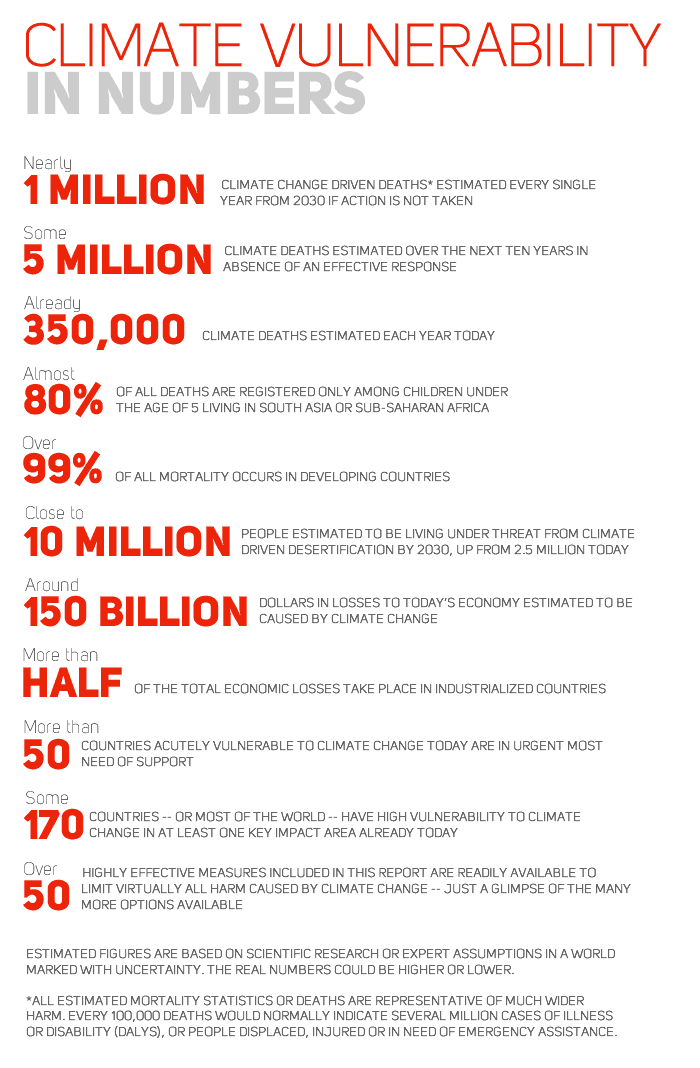
Globally, estimated economic stresses due to climate change point to losses of USD 63 billion each year today. This impact will rise by more than 100% to USD 157 billion each year by 2030.
More Climate Vulnerability Monitor 2010
Globally, estimated economic stresses due to climate change point to losses of USD 63 billion each year today. This impact will rise by more than 100% to USD 157 billion each year by 2030.

There is no clear and simple citizen’s guide to the budget.
The budget speech was additionally turned into a management tool by Yashwant Sinha. Every sentence of the budget speech is put into a spreadsheet, responsibility for implementation is assigned, and quarterly reports are produced about progress of implementation. Through this, the budget speech has become the workplan of government for the year. What gets announced in the budget speech tends to get done. Few things get done in the year other than what is announced in the budget speech.- Ajah Shah, Which type of budget speech is this?
"The 7.5 percent budget deficit target should be achieved comfortablyThe six areas where the budget speech has to deliver
as the expenditure would be the same like last year and the revenue is
picking up," Jayasundera said. He said economic growth would be close
to 7 percent, as earlier forecast.
"The reserves are more than the IMF target. I am optimistic of the IMF
releasing both the third and fourth tranche together," he said.
Jayasundara said he expects tourism revenue to grow to $1 billion
annually from its present $400 million, and foreign direct investment
to boom to $1.5-2 billion annually from around $600 million now.
He said foreign investment inflows should put upward pressure on the
rupee currency. "I see a higher probability for appreciation than
depreciation," he said.
Core public goods are international relations, defence, police and judiciary. These are the foundations of civilised existence. They are pure public goods in that everyone benefits when these are done properly. When law and order conditions are good, a new born child benefits from these without imposing any new cost upon the country.

The report from the chairmen lists some of the best ways to raise revenue and cut spending. But it comes with no enactment strategy. In this climate, asking politicians to end the mortgage deduction and tax employer health care plans and raise capital gains taxes and cut benefits for affluent seniors is like asking them to jump on a buzzing sack full of live grenades. They won’t do it.
Tax revenues capped at 21% of GDP
OMB’s budget-setting process is often seen as its primary role, with the organization’s responsibility for improving government’s management and performance taking a backseat. But the Obama administration has made clear that improving performance across agencies is important to it by appointing a chief performance officer for government and re-energizing the management side of OMB.
We therefore recommend that the bill include a limit of five high-priority goals per agency or perhaps a ceiling across government of no more than 100 goals. These are priorities, after all.
I remember being struck by the power of the approach that Barber invented when I was working as an official in the British government back in 2001. By asking three sets of difficult but very simple questions, the Delivery Unit changed the way that we thought about our jobs. The three themes were:
What journey are you trying to make in terms of the goal? Where are you now and what’s the destination?
What’s your strategy to get there? Why do you think your interventions will work?
How will you monitor progress as you proceed? Do you have the capacity to adjust your strategy as you go along?
Maria Ramos and her Finance Department colleagues were charged with putting in front of South Africa’s ministers and cabinet viable options for reaching economic targets without jeopardizing financial stability. Ramos says nothing was sugar coated.
“In 1996 we had to put a fiscal policy in place that had to say to the nation that if we wanted to achieve a sustainable economic growth path of 6 percent, this was how we would get there. That was our starting point. People often think that the program of growth, employment, and redistribution was about cutting the deficit. That’s not the question we asked. We asked: ‘If we want 6 percent growth, what do we need to have in place to achieve it?’
“Very quickly, we came to the conclusion that you can’t get to 6 percent growth when you have a position of fiscal instability, because you can’t borrow your way out of a crisis. We didn’t want to go to the IMF—we didn’t think that was going to be a sustainable solution—and we were very close to that. South Africa had no reserves—in fact we had a negative reserve position because we had a net open forward position at that point of about $26 billion. We had debt-to-GDP ratios of around 50 percent, we had debt-servicing costs reaching the point where they were unsustainably high. So the fiscal position was pretty precarious: the metrics didn’t add up.
“So if you want to get growth there, you have to fix the base. And fiscal sustainability is hard to achieve and it’s easy to lose. That’s what we placed before policymakers, before the cabinet. And I have to say that, as hard as it was, when faced with that, I never came across a politician from the president down who said: ‘No, we can’t do this because it’s going to be unpopular for me.’ What’s been remarkable for me as a civil servant to see was that politicians from the top down were able to say ‘What is in the best interests of our country? It’s going to be painful, it’s going to be hard.’ Those investments continue to pay off today.”

This may be the most difficult diagram I've ever done. The information and data is swathed in obfuscation, economic jargon and subtle sleight-of-hand definitions and sub-definitions that mask the meaning from interested readers. It was a real struggle. I hope it and the data make sense.


"The observed resilience of the Mauritian economy is a testimony to the positive impact of the reforms carried out since 2006, which favoured economic diversification and adaptation at the same time that it created fiscal space for expansionary macroeconomic policies and other innovative, timely, temporary and targeted responses to cushion the crisis impact".-World Bank, Mr Fabiano Bastos, quoted in the Budget Speech
'The best solutions are those where international experience is judiciously mixed with local genius'-Suhas Joshi
Financial resources expected from development partners (grant or loan funding) have already been factored in the macro-fiscal framework used for working out spending limits and do not therefore constitute an additional source of funds available for spending.
Part of what people like about New Delhi’s metro is that the cars are clean and people are relatively courteous. Some riders are so pleased, in fact, that they volunteer their time to ensure it stays that way. They enforce rules against public spitting and urination. Though such rules are routinely ignored in the rest of the city, the volunteers appear to be winning the battle so far to sustain new norms among metro riders.-How The Times built teacher effectiveness database
Even when cities enforce formal rules against certain kinds of behavior, creating a culture of compliance with the rules can be challenging. The Delhi metro monitors are simply trying to preserve a desirable equilibrium.
The National Commission on Fiscal Responsibility and Reform, co-chaired by former Clinton White House Chief of Staff Erskine Bowles and former Republican Senate Whip Alan Simpson, faces two over-riding problems. First, it must find a new source of revenue for the federal government, a source that is relatively stable, produces substantial proceeds, and does not create large disincentives for employment, saving, and investment. Second, it must bring the rate of growth of health care spending closer to the rate of growth of the rest of the economy. The gap over the last 30 years, 2.8 percent per annum, is unsustainable. As Alice Rivlin, a member of the new commission, has said, “Long-run fiscal policy is health policy.”1 Control of health expenditures will require comprehensive change in the way the country finances and delivers health care. A value-added tax (VAT) dedicated to funding basic health care for all through enrollment in accountable care organizations would help solve the revenue and health spending problems at the same time. A VAT, by itself, has much to recommend it. Unlike a payroll tax, it does not discriminate against employment. Unlike the income tax, it taxes only consumption, not saving. The base (consumer expenditures) is more stable than payroll or income over the business cycle and is large enough to provide a substantial yield at a relatively modest rate. While it is not immune to evasion or avoidance, a VAT is not as vulnerable to these problems as the income tax.

Government agencies increasingly are putting out report cards on cars, schools, restaurants and other offerings to help consumers sort among them. But such grading systems can emphasize simplicity over precision, and decisions about the criteria they use have a significant impact on results. Plus, using letter grades risks lumping together very different performers. In Los Angeles County, 98% of restaurants got A's or B's last year for health safety....-Report Cards for Consumers Don't Always Make the Grade
Different agencies view the grades differently, and that view affects how they construct the grading curve. Florida education officials keep changing their formula for rating schools "to continue to raise the bar" so schools keep seeking progress, says Juan Copa, bureau chief for research and evaluation for the state Department of Education.
The health departments in Los Angeles County and New York view A grades as an incentive for restaurants that improve their practices so they can lure in more customers; therefore, there aren't plans to make it harder to ace the test.
Grading systems inevitably include some criteria while excluding others, and require that choices be made about how to weight those that are included.

Labor-on-demand is cloud computing but with human workers. In the same way you can divide tasks among a bunch of computers to get more processing power, you can get scalable, parallel work with our online workforce.
The objectives of the project are to (i) implement the public cost system in phases, starting with four pilot entities (health, education, prisons, and social assistance); (ii) develop a cost methodology adequate to the public services at the state level; (iii) organize seminars, courses, and other training events to educate the state officials on how to prepare and use cost information; (iv) document the cost methodology used in the existing projects; (v) prepare guidelines for external dissemination of cost data; and (vi) prepare progress reports.
The first is for technical PFM missions to become less purely technical...
Take, for example, a recommendation that I found in a recent report on a middle-income country with a distinctively Southern European approach to public administration. This was to establish a top-down budget preparation process, in which the cabinet of ministers would play a key role in debating fiscal policy options, and setting multi-annual ceilings on budgetary expenditure. A related recommendation was to establish a system of periodic expenditure review, as used quite successfully in countries such as the Netherlands and the U.K.
...Unfortunately, in relation to the country concerned they make very little sense because (i) the cabinet system is weak and would require a complete overhaul to make it work on the lines suggested, an outcome which seems politically implausible; (ii) the government is a weak coalition, unlike in many Anglo-Saxon countries which have one-party governments, and has no proven capability to make hard choices about public expenditure; (iii) the ministry of finance is politically fragmented, weakly led and has limited capacity to undertake the technical analysis which would be necessary to improve the efficiency of the expenditure prioritization process...
... My suggestion would be that technical PFM missions mounted by the Fund or Bank should include a political economy expert whose job should be to carry out the necessary institutional analysis and subject the recommendations of the PFM technicians to a rigorous reality check before they are put onto paper. Greater use could also be made of local consultants with an in-depth knowledge of both public finance and the institutional environment...
My second suggestion is that technical assistance reports should never be the end-point of a process of intervention by the Bank or Fund. To prevent such reports being quietly put on a shelf in the minister’s back office, and left to gather dust, they should always be the starting point of a discussion and dialogue with the finance ministry on the analysis undertaken by the mission, and its findings and recommendations,..
Instead of reports containing 50 or more recommendations compressed into a complex multi-annual action plan, the outcome of such a dialogue should be, for the average developing country, a much smaller subset – say three or four, at most -- of carefully selected actions that could realistically be undertaken during a 4-5 year period, and which stand a reasonable chance of being implemented.
China has adopted this approach for many years, with some success. Rather than asking the Bank or Fund to mount a full-blown technical assistance mission, the authorities propose a seminar on accounting or budget classification or budget preparation to which they invite specialists from a range of countries. The emphasis is on learning, engaging in a dialogue with experienced counterparts, and translating the experience of others into ideas which might (or might not) be relevant to the Chinese experience, their institutions and decision-making processes.
Richard Allen is currently working on a project with the World Bank that is analyzing the role and responsibilities of central finance agencies (CFAs) in low-income countries. A database covering 70-80 countries is being prepared, along with case studies of selected countries. The project includes a strong emphasis on the analysis of political economy and institutional characteristics of CFAs.

“Mahmoud Mohieldin has proven himself a tireless reformer whose work on economic and financial reform helped Egypt weather the global financial crisis. An outstanding young leader, his first hand experience of development and of the World Bank -- both as Minister and as World Bank Governor -will serve us well as we undertake our own reform program and scale-up our client focus,” said Zoellick.
We put specific timelines. We didn’t really hesitate to continue with the reforms despite the criticism at the beginning, and I have to admit that we are very lucky, because when we were conducting these reform measures, we were expecting that their impact on investment and growth was going to be taking at least three to four years. It actually took around two to three years, because of the benign emerging markets environment, and the fact that the economy at large was recovering from a long period of recession. And so with elements of recovery, a benign emerging markets environment, and credible economic policies, we managed to achieve what we have achieved so far...On the Reform of Business Environment: The Case of Egypt
It’s led by the minister of finance, with my membership, the minister of economic development, minister of trade and industry, governor of central bank.We meet every Monday evening.
My six-year reform experience was like driving a reform bus on a long journey, eliciting passengers along the way to a shared destination-Florence Kuteesa
1. Overview of Ugandan Economic Reform since 1986
This synthesis chapter draws out the main findings from the individual chapters. After much agonizing over the direction of economic policy, three fundamental reforms between 1990 and 1992 —legalization of the parallel foreign exchange market, liberalization of coffee marketing, and the establishment of fiscal discipline — brought macroeconomic stability. Together with trade liberalization and privatization, Uganda was set on the road to a liberal, capitalist economy. Concern that growth was bypassing the poor led to a focus on poverty reduction between the mid 1990s and early 2000s. Measures such as decentralization, the Poverty Eradication Action Plan, the Medium Term Expenditure Framework, the Poverty Action Fund, and Sector Working Groups succeeded in attracting increased aid and channeling it into poverty reduction. Sound economic management and a clear commitment to poverty reduction together explain why Uganda was the first beneficiary of both HIPC debt relief and the shift from project aid to budget support. The resulting increase in public service delivery contributed to rapid poverty reduction. The pace of reform has eased since 2002. The chapter concludes by emphasizing the crucial importance of political support for successful economic reform.
2. Institutional and Political Dimensions of Economic Reform
This chapter provides the institutional and political context for the technical reforms discussed in subsequent chapters. It summarizes the abortive attempts at reform of the Obote II government and discusses changes made by the NRM to the economic institutions it inherited in 1986. The long, heated debate over the direction of economic policy was resolved with the merger of the finance and planning ministries and the establishment of fiscal discipline in 1992. The critical role of the President in key economic decisions such as fiscal discipline, the commitment to poverty reduction, and the sale of Uganda Commercial Bank is highlighted. The role of Parliament has increased with the restoration of democracy. The chapter also examines how the finance and planning ministry became one of the strongest in Africa.
3. Exchange Rate, Fiscal, and Monetary Policy
This chapter identifies three phases in Uganda's transformation from a war-torn economy into one that has sustained rapid growth and low inflation since 1992. There were two major reforms in the early 1990s. First the parallel foreign exchange market was legalized in 1990. Following the merger of the finance and planning ministries in 1992, a sharp fiscal adjustment established fiscal discipline and reduced inflation to single figures. The second phase was one of unconventional macro policy for the rest of the 1990s. With little scope for monetary policy, low inflation was sustained largely by tight, short-term fiscal control. In the 2000s, financial deepening and budget reforms have provided a foundation for a more orthodox mix of fiscal and monetary policy.
4. Public Service Restructuring and Pay Reform
This chapter discusses two elements of Public Service reform of particular relevance to the overall economic reform programme the restructuring of the Public Service and pay reform. It highlights the halving of the size of the Public Service between 1990 and 1995 and the subsequent increase following the Poverty Eradication Action Plan commitment to increased provision of basic public services. It also looks at the collapse in real wages during the 1980s and examines progress towards paying public servants a ‘living wage’.
5. Tax Reform
By 1990 tax revenue in Uganda had declined to 5% of GDP. Revenue was heavily dependent on export taxes, which discouraged exports. This chapter discusses the policy and administrative measures taken during the 1990s to make the tax system more transparent and productive. Export taxes were replaced by import taxes, which were progressively reduced to relatively low levels. The most significant single reform was the introduction of Value Added Tax in 1996. Despite initial resistance by traders, strong political support enabled VAT to take root. The Uganda Revenue Authority has spearheaded revenue administration reform since 1991. This chapter discusses the key drivers in setting up an autonomous revenue agency, the successes and challenges in revenue administration, and what could have been done better. It also looks at the challenges and lessons of implementing VAT in an environment of low tax compliance.
6. Planning and Development Budget Reform, 1990–1995
The NRA victory triggered substantial aid flows, accounting for over half of public expenditure. However, the planning and budgeting systems had collapsed,; so donors largely did their own thing and much aid was ineffective. This chapter describes the measures adopted to establish some order and bring government policy priorities to bear on donor allocations and public expenditure generally. It discusses the key reforms, designed to attract increased aid and improve the effectiveness of all public expenditure: the merger of the finance and planning ministries; consolidating responsibility for sector policy, planning, and budgeting in a single division; capturing aid in the plan and budget; integration of the plan and development budget; establishment of internal review processes and the challenge function; and management of counterpart funding. Aspects of Uganda's ‘legacy’ are highlighted, such as: the Paris Declaration principle that aid should align behind government plans; the PIP as the forerunner of the Poverty Eradication Action Plan and poverty reduction strategies; linking plan and budget; and Public Expenditure Tracking Surveys.
7. The Poverty Eradication Action Plan
Uganda was a pioneer in designing a holistic, comprehensive development plan targeted at poverty eradication. The 1997 Poverty Eradication Action Plan was the original prototype ‘poverty reduction strategy’, which is now a prerequisite for countries wishing to access HIPC, World Bank, IMF, and other donor support. This chapter shows how the PEAP developed from the Public Investment Plan of the early 1990s through an extensive consultative process. It discusses the influence of the PEAP on resource allocation and sector policies. It describes how the PEAP has evolved during subsequent revisions, the changes in the institutional framework for planning and monitoring, and the efforts to maintain the relevance of the PEAP over time.
8. Budget Reform and the Medium Term Expenditure Framework
The initial budget reforms from 1992, aimed at establishing macroeconomic stability and credibility of the budget, focused on the short term. This chapter shows how, once these immediate targets were achieved, the finance and planning ministry gradually implemented a Medium Term Expenditure Framework. This was intended to facilitate a realignment of public expenditure in line with the political priorities set out in the Poverty Eradication Action Plan and to improve the predictability of public funds, while adhering to the aggregate resource envelope. The chapter examines trends in sector allocations, to assess whether the MTEF facilitated significant shifts, and looks at progress towards improving the predictability of the budget. It also discusses the pioneering measures taken to promote public and political consultation on the budget. Other reforms discussed include the virtual Poverty Action Fund, output oriented budgeting, fiscal transfers to local government, and public expenditure reviews.
9. Sector Wide Approach and Sector Working Groups
Once fiscal discipline had been restored and basic expenditure management systems established at the central level, the finance and planning ministry increasingly turned its attention to expenditure at the sector level. This chapter discusses the evolution of Sector Working Groups and Sector Wide Approaches. It shows how responsibility for drawing up sector policy and expenditure priorities was increasingly delegated to SWGs. These were led by sector ministries but included representatives from other government institutions in the sector, the finance ministry, donors, and civil society. They assumed an increasingly important formal role in determining sector allocations in the budget process. The chapter shows how SWAps emerged as a mechanism which fused the policy, planning and budget processes through the development of inclusive sector investment plans, budgets to implement those plans, and joint monitoring mechanisms. They helped develop common donor approaches within sectors, improving alignment to government policies, and promoting the use of government systems.
10. Poverty Monitoring
Political concern that rapid economic growth did not appear to be benefiting the poor led to an increased focus in the mid-1990s on ensuring public expenditure was pro-poor and on monitoring poverty trends. This chapter discusses the measures adopted to increase the poverty focus of the budget. It also looks at the institutional arrangements and the methods used to monitor poverty trends. Household survey data shows that between 1992 and 2006 Uganda experienced one of the largest and fastest reductions in income poverty recorded anywhere in modern times. Participatory Poverty Assessments, which were pioneered in Uganda, and other non-quantitative methods illustrate the multi-dimensional nature of poverty and the unevenness of progress towards poverty reduction.
11. Statistics Reform
Many of the economic reforms were dependent on reliable statistics. Like many other government systems, statistics collection virtually collapsed during the 1970s. This chapter shows how systems for collecting, analysing, and disseminating official statistics have been rebuilt since the late 1980s. It starts with a historical review of statistics institutional development before going on to look at the main categories of statistics currently collected, and at their analysis and dissemination.
12. Debt Management and Debt Relief
This chapter shows how the rapid accumulation of debt from 1986 led to a debt crisis in 1990. It discusses the debt management strategies adopted following the crisis to ensure that it would not recur. Paris Club rescheduling and commercial debt buy-back helped reduce the stock of arrears. However, this increased the share of multilateral debt, which could not be rescheduled, to 75%. Uganda was in the vanguard of the debt relief movement of the 1990s, which culminated in the Highly Indebted Poor Countries initiative, and was the first country to benefit from HIPC. This chapter shows how sound economic management and a strong commitment to poverty reduction underpinned the case for multilateral debt relief in a country where debt was vividly crowding out social expenditure. It also looks at Uganda's role in the HIPC initiative and shows the impact of debt relief on debt service costs.
13. Aligning Aid with Government Fiscal Objectives
This chapter evaluates efforts by the government to encourage donors to shift their aid into budget support and to ensure that aid flows were consistent with the government's macroeconomic objectives for fiscal policy and its strategic expenditure priorities. Aid to Uganda rose sharply in the second half of the 1990s, funding a major expansion of public expenditure. This was accompanied by a shift in aid modalities, from projects to budget support, in line with government preferences. Uganda was in the forefront of the rapid growth in budget support, which has been one of the most profound developments in the aid business in recent years. The chapter examines the key institutional reforms intended to encourage the shift towards budget support and looks at some of the problems encountered with aligning budget support with the Medium Term Expenditure Framework. It also examines the reasons for government's strategic objective of reducing the budget's dependence on donor aid.
14. Fiscal Decentralization
In the 1990s Uganda embarked on an ambitious programme of political, fiscal, and administrative decentralisationization reforms as a means of rebuilding and expanding the delivery of basic services, and fostering local democracy and accountability. This chapter examines the roots and evolution of the reforms, focusing on the fiscal side of decentralisationization. It examines how a rapid expansion in central grants helped support the expansion of basic services, the tension between centralised funding and local autonomy, the stagnation of local taxation, the incentives for and establishment of public financial management capacity, and the evolution of planning and budgeting systems. It concludes by asking whether the decentralisationization process was managed in a way that helped or hindered the expansion of basic services.
15. Financial Management and Accountability Reform
Macroeconomic stability and increased growth were achieved in the early 1990s despite very weak financial management and accountability systems. This chapter shows how these weaknesses became even more pronounced following the adoption of the 1995 Constitution, decentralization, expanding budgetary demands, and the requirements of the Poverty Eradication Acton Plan, among others. Strengthening public financial management and accountability was critical if progress was to be sustained and if donors were to be persuaded to channel more aid through government systems. Yet in 1998 the entire government had just two professional accountants. The chapter presents the key reforms adopted to strengthen financial management and accountability, looking at changes in the areas of the legal and policy framework, institutional capacity building, and processes and systems, particularly the introduction of the Integrated Financial Management System.
16. Privatization and Parastatal Reform
By the late 1980s Uganda's large public enterprise sector had become a major drain on the Treasury and a bottleneck to economic growth. To address this situation the government embarked on a major privatization and public enterprise reform programme in 1993. By 2005 the programme was largely complete and most public enterprises had been privatized, reformed, or closed down. This chapter discusses the key issues, reforms, and institutions that were central to the divestiture and reform of public enterprises. The implementation process is discussed along with the various methods adopted, the numbers that were divested and the proceeds from the process. The chapter identifies the key challenges faced during the process and assesses the impact of the reforms on issues such as government finances and post-divestiture performance. It concludes with an appendix on utility reform.

As Gov. David A. Paterson calls lawmakers back to work on the budget this week, he has announced that the fiscal situation is so serious that he must begin laying off state workers. But there is one wrinkle, as officials try to pare government spending: No one knows for sure how big the state work force actually is.
That is because the state has not one but two public payrolls.
One is controlled by the governor, encompassing about 131,000 employees, who toil for agencies like the Health Department, the parks department and the Department of Motor Vehicles. That payroll has shrunk by about 25 percent in the last two decades — so has the much smaller legislative payroll — and usually shoulders the brunt of layoffs.
The other lies beyond the direct control of the governor and includes perhaps 163,000 more workers employed by independent public authorities and agencies — though that number is an estimate, because not all authorities have been reporting their payrolls to a central state registry. And projections of state employment by the federal government do not always match the state government’s figures. The work force beyond the governor’s control has largely bucked the statewide retrenchment, according to a review compiled by The New York Times...
Legislation last year forced them for the first time to turn over their employment data to a central registry. But that represents only current staffing, making it difficult to determine whether the authorities have been shrinking or expanding over time.
Mr. Orszag, you may recall, was the administration’s main proponent of “bending the curve” on health care expenditures. Frustrated that House Democrats wouldn’t accept some painful cost-cutting measures in the new health care law, Mr. Orszag pushed for and won a controversial provision to create something called the Independent Payment Advisory Board. This is an outside commission of 15 appointees who will, beginning in 2014, identify cuts to Medicare if the plan exceeds a preset rate for growth. Congress then has to either approve the cuts or propose an alternative.-Budget Chief tried to tilt power to Executive Branch
The significance of this new advisory board goes well beyond the immediate question of how to rein in Medicare costs. Mr. Orszag, who declined to be interviewed, has said that the board represented, for Congress, the “single-biggest yielding of power to an independent entity since the creation of the Federal Reserve.” In other words, the Medicare Board isn’t only a means of cutting government spending; it is a means, too, of wresting the constitutional responsibility for budgeting away from powerful committee chairmen.
The Medicare Board may be the most striking example of this strategy, but it is hardly the only one. Mr. Orszag also helped broker the creation of an 18-member debt commission that will offer specific alternatives for re-ordering the federal budget. The administration has also proposed a bill — known in the punchy language of Washington as “expedited rescission authority” — that would effectively give the president the power to strike out spending items after the budget has been approved.
He had come to understand the defining human struggle not as left versus right, or faith versus reason, but as individual versus institution. As a student of Kafka, Koestler, and Solzhenitsyn, he believed that truth, creativity, love, and compassion are corrupted by institutional hierarchies, and by “patronage networks”—one of his favorite expressions—that contort the human spirit. He sketched out a manifesto of sorts, titled “Conspiracy as Governance,” which sought to apply graph theory to politics. Assange wrote that illegitimate governance was by definition conspiratorial—the product of functionaries in “collaborative secrecy, working to the detriment of a population.” He argued that, when a regime’s lines of internal communication are disrupted, the information flow among conspirators must dwindle, and that, as the flow approaches zero, the conspiracy dissolves. Leaks were an instrument of information warfare.-Julian Assange’s mission for total transparency
These ideas soon evolved into WikiLeaks. In 2006, Assange barricaded himself in a house near the university and began to work. In fits of creativity, he would write out flow diagrams for the system on the walls and doors, so as not to forget them. There was a bed in the kitchen, and he invited backpackers passing through campus to stay with him, in exchange for help building the site. “He wouldn’t sleep at all,” a person who was living in the house told me. “He wouldn’t eat.”
As it now functions, the Web site is primarily hosted on a Swedish Internet service provider called PRQ.se, which was created to withstand both legal pressure and cyber attacks, and which fiercely preserves the anonymity of its clients. Submissions are routed first through PRQ, then to a WikiLeaks server in Belgium, and then on to “another country that has some beneficial laws,” Assange told me, where they are removed at “end-point machines” and stored elsewhere. These machines are maintained by exceptionally secretive engineers, the high priesthood of WikiLeaks. One of them, who would speak only by encrypted chat, told me that Assange and the other public members of WikiLeaks “do not have access to certain parts of the system as a measure to protect them and us.” The entire pipeline, along with the submissions moving through it, is encrypted, and the traffic is kept anonymous by means of a modified version of the Tor network, which sends Internet traffic through “virtual tunnels” that are extremely private. Moreover, at any given time WikiLeaks computers are feeding hundreds of thousands of fake submissions through these tunnels, obscuring the real documents. Assange told me that there are still vulnerabilities, but “this is vastly more secure than any banking network.”
Before launching the site, Assange needed to show potential contributors that it was viable. One of the WikiLeaks activists owned a server that was being used as a node for the Tor network. Millions of secret transmissions passed through it. The activist noticed that hackers from China were using the network to gather foreign governments’ information, and began to record this traffic. Only a small fraction has ever been posted on WikiLeaks, but the initial tranche served as the site’s foundation, and Assange was able to say, “We have received over one million documents from thirteen countries.”


